The Future of Scaling: How AI Employees Are Revolutionizing Workflows for Growing Businesses
AI AutomationBusiness AutomationDigital TransformationWorkflow AutomationTech TrendsEnterprise Solutions- Date : Mar 19
- Time : 6 Min Read
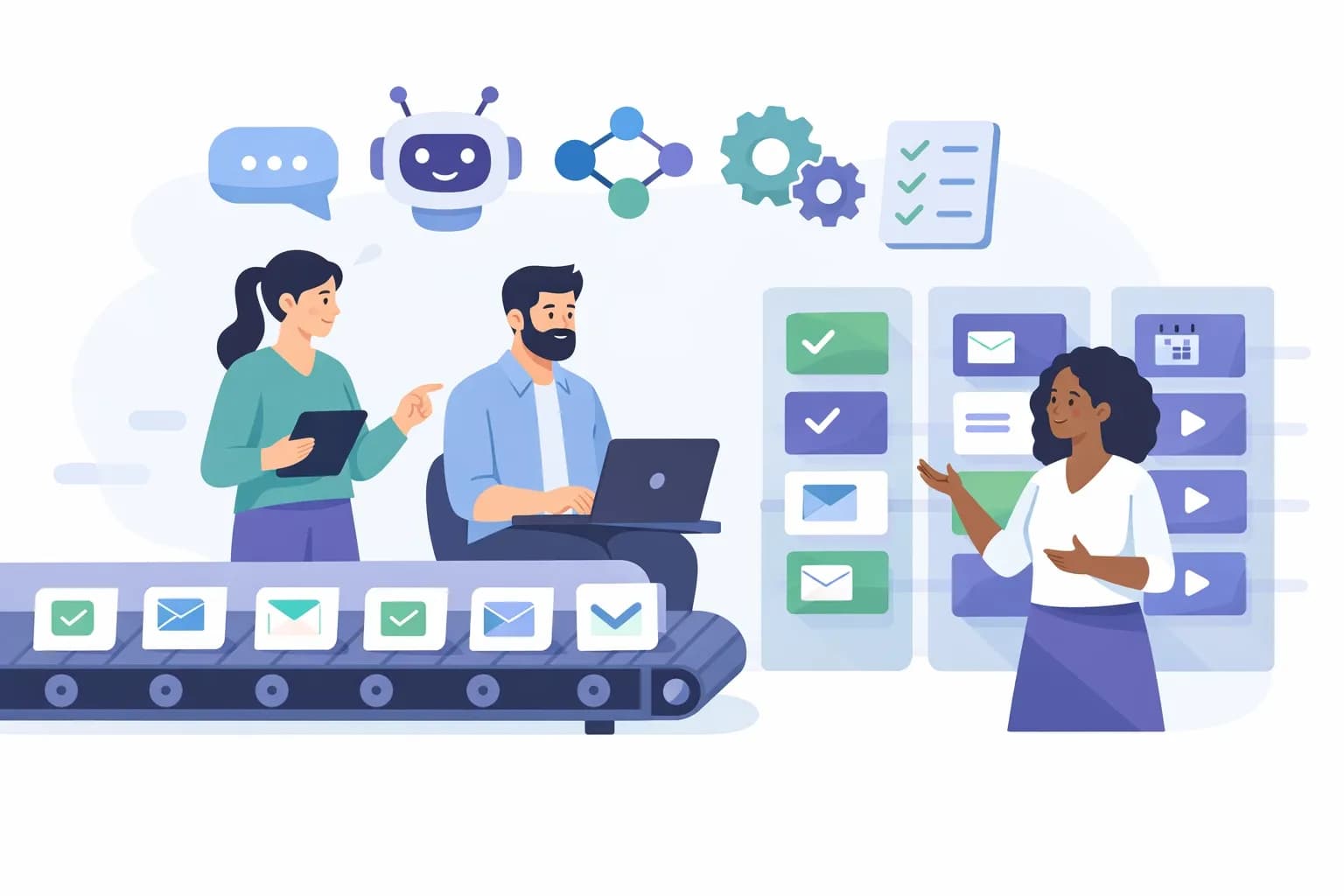
1. Introduction: From Tools to Autonomous Agents
Automation used to mean fixed rules: “if X happens, do Y.” That still matters, but the bigger shift in 2026 is that AI is moving from passive tools (write a draft, summarise an email) to autonomous agents that can interpret intent, choose actions, and complete multi-step work across systems.
This is the practical frontier of ai workflow automation: not just speeding up tasks, but redesigning how work moves through your business.
2. The Concept: “AI Employees” as the Next Frontier
An AI employee is best understood as an agent with a role, responsibilities, and guardrails. Instead of asking an AI to do one thing at a time, you define:
- A job to be done (e.g., qualify leads, handle first-response support)
- Approved tools and access (CRM, inbox, helpdesk, calendar)
- Policies (what it can’t do, when to escalate, what to log)
For growing businesses, this maps closely to business process automation uk priorities: fewer hand-offs, faster response times, and better consistency, without scaling headcount linearly.
3. Practical Roles: Where AI Employees Add Value
AI employees add the most value in workflows that are high-volume, time-sensitive, and rules-plus-judgement (not purely repetitive). Here are clear, role-based examples:
- Lead generation and qualification: follows up on inbound enquiries, asks the right questions, and updates your CRM with structured notes.
- Receptionist/calls and first-response support: triages new requests, routes them to the right person, and resolves common questions using your knowledge base.
- Legal/operations coordination: prepares standard documents, checks process steps, and keeps admin tasks moving with auditability.
- Blog writing and content ops: turns subject-matter notes into publishable drafts, outlines, and content refresh plans.
- Social media and campaign support: repurposes content into channel-specific posts and maintains a consistent publishing cadence.
- Executive assistance: manages scheduling, meeting summaries, action lists, and follow-ups.
The point is not to “replace departments.” It is to remove bottlenecks, keep work flowing, and give your team space for higher-value decisions.
4. The Platform: Marblism as an AI Employee Ecosystem
Platforms are emerging that package these role-based agents into usable systems. One of the better-known ecosystems is Marblism, which positions its product around pre-built AI employees and templates you can adapt to real business workflows.
That ecosystem approach matters because “AI employees” are only useful when they can operate inside the tools you already run: websites, CRMs, inboxes, helpdesks, and internal apps.
5. The Synergy: Marblism + TeqFlo Is a Practical Match
Marblism can save time by providing the agent layer and role structure. The difference between “interesting” and “operational” is integration, data design, and UX.
At TeqFlo, we bring 14 years of expertise in web, software, and app development. That foundation helps ensure AI employees are implemented in a way that is:
- Integrated: connected properly to your website, CRM, databases, and internal tools.
- User-friendly: automation is paired with great UX so staff and customers actually want to use it.
- Reliable: workflows are designed with clear escalation paths, logging, and safety boundaries.
In practice, this is a strong combination: use Marblism to reduce manual workload, and use TeqFlo to automate your business needs while still delivering high-quality websites and applications.
6. Conclusion: Scaling with AI, Without Losing Control
AI employees are becoming a practical operating layer for growing businesses: faster execution, more consistency, and less busywork. The organisations that get the most out of this wave will be the ones that treat AI as a system design challenge: roles, guardrails, integrations, and user experience.
If you want to identify one workflow to automate end-to-end (and do it safely), contact our team.