Top 5 LLMs in 2026: Predicting the Leading Large Language Models
AI AutomationSoftware DevelopmentDigital TransformationBusiness AutomationMachine LearningTech TrendsEnterprise Solutions- Date : Jan 15
- Time : 6 Min Read
The landscape of artificial intelligence is evolving at a breathtaking pace, with Large Language Models (LLMs) at the forefront of this transformation. By 2026, the field is expected to be dominated by a select group of models that excel in reasoning, multimodality, and real world application. This article predicts the top 5 LLMs in 2026, analysing their expected capabilities, architectural innovations, and potential impact on business and technology. The race for AI supremacy is heating up, and these are the frontrunners poised to lead.
GPT-5: OpenAI's Flagship Multimodal and Reasoning Powerhouse
As the successor to GPT-4, OpenAI's GPT-5 is widely anticipated to be a benchmark setter. It is expected to solidify its position by perfecting the balance between speed, intelligence, and multimodal understanding.
GPT-5 (OpenAI) GPT-5 is OpenAI's flagship model, predicted to set industry standards with native multimodality, extended context windows up to 400,000 tokens, and advanced reasoning capabilities. It builds on chain of thought techniques for complex problem solving and integrates deeply into enterprise workflows.
Pros
- Native multimodal processing of text, images, audio, and video.
- Extremely long context windows for analysing lengthy documents or codebases.
- Sophisticated reasoning for scientific research and code generation.
- Strong integration with popular platforms and APIs for automation.
Cons
- Likely high API costs and computational requirements.
- Potential concerns over data privacy and proprietary limitations.
- May face ethical scrutiny due to its widespread influence.
What You Should Use It For Use GPT-5 for enterprise workflow automation, advanced content creation across multiple media, complex coding projects, and scientific analysis where deep reasoning and multimodality are critical. It is ideal for businesses seeking a versatile, powerful AI assistant integrated into existing tools.
Claude: Anthropic's Ethical and Enterprise Focused AI Assistant
Anthropic's Claude models have carved a niche by prioritising safety, honesty, and helpfulness through their Constitutional AI framework. By 2026, this focus on reliable, enterprise grade AI will make it a top contender.
Claude (Anthropic) Claude is Anthropic's AI assistant, emphasising ethical alignment, trustworthiness, and enterprise readiness through Constitutional AI. It excels in handling long form content with high accuracy and complex reasoning tasks, making it suitable for regulated industries.
Pros
- High safety and reduced bias outputs due to Constitutional AI.
- Superior long context handling for legal, financial, or healthcare documents.
- Advanced reasoning modes for debugging code or auditing contracts.
- Strong compliance features for industries with strict standards.
Cons
- May be less flexible or creative compared to more open ended models.
- Potentially slower response times in complex thinking modes.
- Limited integration outside Anthropic's ecosystem.
What You Should Use It For Use Claude for legal document analysis, financial auditing, healthcare compliance tasks, and software development requiring ethical, reliable outputs. It is perfect for businesses in regulated sectors that need trustworthy AI with robust reasoning capabilities.
Gemini: Google's Integrated Multimodal Model with Deep Reasoning
Google's Gemini family benefits from unparalleled integration with the company's vast ecosystem of services and data. By 2026, Gemini is poised to be a deeply embedded, intelligent layer across Google's products and the wider web.
Gemini (Google) Gemini is Google's multimodal model, leveraging real time data from Search, Workspace, and other services. It offers deep reasoning with step by step logic and efficient specialised variants for different tasks, from analysis to speed sensitive applications.
Pros
- Real time data integration from Google's ecosystem for up to date insights.
- Deep reasoning modes with clear logical explanations.
- Tiered variants (e.g., Pro for analysis, Flash for speed) for efficiency.
- Seamless integration with tools like Calendar, Sheets, and marketing platforms.
Cons
- Dependency on Google's services may raise data privacy concerns.
- Potential vendor lock in for businesses heavily invested in Google.
- May lack the customisation options of open source models.
What You Should Use It For Use Gemini for real time data analysis, scheduling and productivity tasks in Google Workspace, marketing automation campaigns, and customer engagement where integration with existing Google tools is key. It is ideal for businesses using Google's ecosystem for streamlined operations.
Llama 4: Meta's Open and Efficient Mixture of Experts Model
Meta's Llama series has democratised access to powerful LLMs. Llama 4, predicted for release by 2026, will advance the open source model paradigm with a focus on efficiency and scalability through a Mixture of Experts (MoE) architecture.
Llama 4 (Meta) Llama 4 is Meta's open source model, featuring a Mixture of Experts architecture for computational efficiency. It supports massive context windows, multimodal capabilities, and is freely available for customisation, fostering innovation without vendor lock in.
Pros
- Open source accessibility for download, fine tuning, and deployment.
- Efficient MoE architecture reducing operational costs.
- Extremely long context windows for processing codebases or datasets.
- Native multimodal features for creative and analytical tasks.
Cons
- May require technical expertise to deploy and maintain locally.
- Performance might lag behind proprietary models in some benchmarks.
- Limited official support compared to commercial offerings.
What You Should Use It For Use Llama 4 for custom AI solutions in research, software development, or data analysis where cost efficiency and customisation are priorities. It is excellent for businesses wanting to avoid vendor lock in and innovate with tailored models, as seen in trends for open AI tools.
DeepSeek V3.1: The Cost Effective Open Model Challenger
Representing the rise of highly competitive open source models, particularly from Chinese innovators, DeepSeek V3.1 is predicted to be a disruptor. It demonstrates that open models can match or even surpass proprietary ones in specific benchmarks, all while being more cost effective to develop and run.
DeepSeek V3.1 (DeepSeek) DeepSeek V3.1 is a cost effective open source model known for benchmark competitiveness in mathematical reasoning and coding. It challenges proprietary models with efficient architectures, driving innovation and lowering costs in the AI landscape.
Pros
- High performance in STEM related tasks like maths and coding.
- Cost effective development and operation compared to proprietary models.
- Drives open source innovation and broadens AI competition.
- Efficient training approaches for specialised applications.
Cons
- May have fewer multimodal features than leading proprietary models.
- Potential language or regional biases in training data.
- Less integration with mainstream enterprise tools.
What You Should Use It For Use DeepSeek V3.1 for mathematical problem solving, coding tasks, STEM research, and applications where budget constraints are a concern. It is suitable for developers and researchers looking for high performance in specific domains without high costs.
Key Trends Shaping LLMs in 2026: Reasoning, Multimodality, and Open Innovation
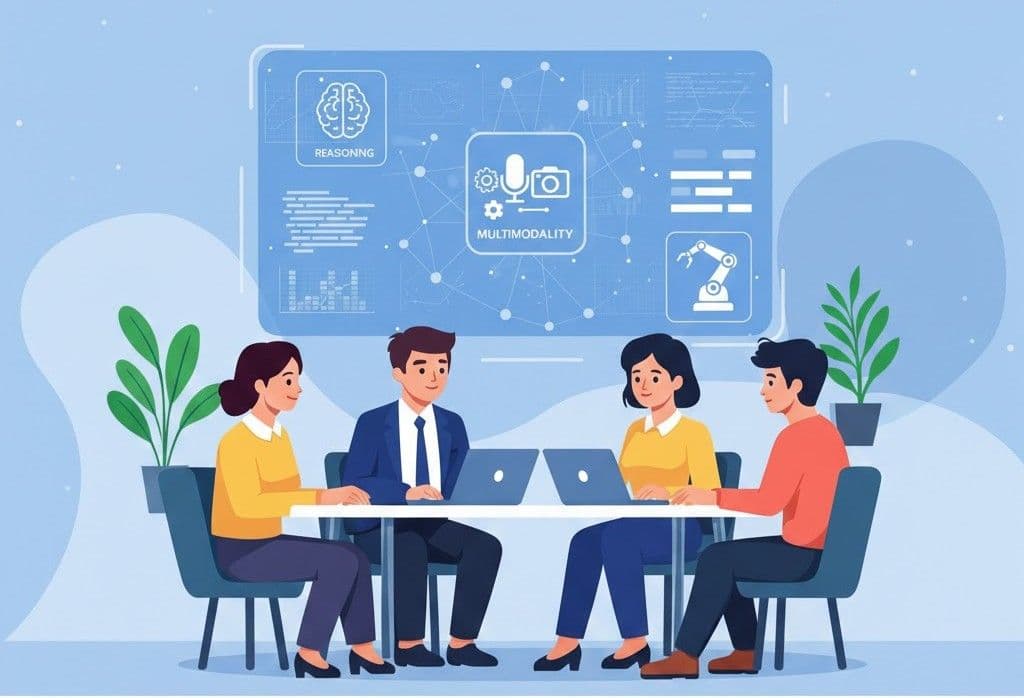
The dominance of these top 5 LLMs in 2026 will be underpinned by several convergent trends. First, the shift from mere text prediction to true reasoning and problem solving will be paramount. Models will increasingly explain their chain of thought, making them more transparent and useful for critical tasks.
Second, multimodality will be the default. The leading LLMs will not just understand text but will see, hear, and generate content across multiple mediums seamlessly. Finally, the healthy tension between proprietary and open source models will continue to drive progress. Open models like Llama and DeepSeek will push the frontier on efficiency and accessibility, while proprietary models will race ahead on raw capability and deep ecosystem integration.
Latest AI News and Developments Impacting LLMs
As of late 2024 and early 2025, several developments are shaping the trajectory towards 2026. OpenAI has been focusing on enhancing agentic capabilities, allowing models to perform multi step tasks autonomously. This directly impacts predictions for GPT-5's workflow automation potential.
Google has accelerated Gemini's integration into its core products, making real time data access a key differentiator. Anthropic continues to refine Claude's Constitutional AI framework in response to increasing regulatory scrutiny, particularly in the EU and US.
In the open source arena, Meta's release of Llama 3.1 with improved MoE efficiency provides a clear roadmap for Llama 4's anticipated performance. Similarly, DeepSeek's recent models have shown remarkable gains in mathematical benchmarks, reinforcing its predicted niche strength.
These developments underscore the rapid pace of innovation in reasoning, multimodality, and open source competition that will define the top LLMs in 2026.
Ethical Considerations and Future Challenges for LLM Development
As these models become more powerful and integrated into daily business operations, ethical challenges will intensify. Issues of bias, misinformation, data privacy, and job displacement require proactive governance. The leading companies will be those that not only build the most capable AI but also demonstrate the most robust commitment to safety and ethical deployment.
Furthermore, the ability of LLMs to act as autonomous agents, performing complex multi step tasks online, will raise new questions about security and accountability. Businesses looking to leverage these technologies, perhaps for test automation or customer interaction, must implement them with careful consideration of these broader implications. The future belongs to models that are not only intelligent but also trustworthy and aligned with human values.